
Thursday, May 1, 2008

Friday, April 25, 2008


Wednesday, April 23, 2008
Final Project
For my final project, I ended up writing a paper on how comics/graphic novels serve as a sort of a subversive element in mainstream society/popular culture. It's kind of a twist on my proposal because I realized that my proposal would require a 20-page paper to complete. I think my topic works, but there's still a chance I'll be scrapping the rough draft and starting over. I'm just no good at choosing my own topic. Give me a prompt any day.
I know we were originally assigned an essay, but after reading about all the cool "choose your own topic" projects that people are doing, my standard essay is starting to look a little lame.
For my final project, I ended up writing a paper on how comics/graphic novels serve as a sort of a subversive element in mainstream society/popular culture. It's kind of a twist on my proposal because I realized that my proposal would require a 20-page paper to complete. I think my topic works, but there's still a chance I'll be scrapping the rough draft and starting over. I'm just no good at choosing my own topic. Give me a prompt any day.
I know we were originally assigned an essay, but after reading about all the cool "choose your own topic" projects that people are doing, my standard essay is starting to look a little lame.
Wednesday, April 16, 2008
The little in-class activity we did on Monday? Ended up being really hard! For the life of us, my group couldn't put together a coherent and eloquent sentence musc less a paragraph about the panel from Epileptic. Translating pictures into words is so much harder than translating one language into another (from some one who tested at having taken two years of German in high school when I had taken four, this means something).
Cliche alert!
I guess a pictures really is worth a thousand words... :)
Some one always posts one of these at the end of their blog post, but I don't remember who. Anyway, here's one that one of my friends made of two of my other friends. I thought it was pretty funny.

Cliche alert!
I guess a pictures really is worth a thousand words... :)
Some one always posts one of these at the end of their blog post, but I don't remember who. Anyway, here's one that one of my friends made of two of my other friends. I thought it was pretty funny.
Monday, April 14, 2008
Berlin, Chapters 1-4

"I hope it will add up to more than a pile of stones" (p. 80)
I'm not sure this is exactly what Herr Severing is talking about, but I can't help but to think of images like this anyway.
The first major European city I ever went to, thankfully was Prague, Czech Republic. Prague is the only major European city not bombed in the war. It is glorious.
My dream city to go to had always been Vienna, but when I went, I somehow forgot that it, unlike Prague, had been bombed out. I was still thinking about Prague, of streets that wonderful composers and writers had walked on centuries before. Vienna is surrounded on its periphery by government-subsidized housing slums. I do not want to go back to Vienna.
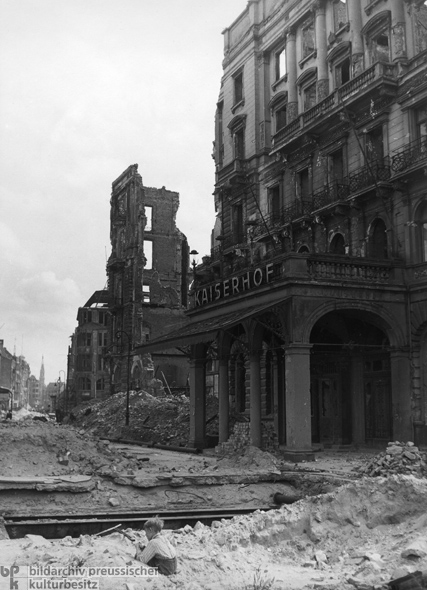
"I hope it will add up to more than a pile of stones" (p. 80)
I'm not sure this is exactly what Herr Severing is talking about, but I can't help but to think of images like this anyway.
The first major European city I ever went to, thankfully was Prague, Czech Republic. Prague is the only major European city not bombed in the war. It is glorious.
My dream city to go to had always been Vienna, but when I went, I somehow forgot that it, unlike Prague, had been bombed out. I was still thinking about Prague, of streets that wonderful composers and writers had walked on centuries before. Vienna is surrounded on its periphery by government-subsidized housing slums. I do not want to go back to Vienna.
Monday, April 7, 2008
Like our class, Alison Bechdel has her own blog.
Unlike our class, hers is about as exciting as watching paint dry.
That's okay though, because her blogs leads you to some of the interesting YouTube videos she's posted.
Like this one, where she explains and demonstrates her artistic process:
Pretty neat. Time consuming too.
Unlike our class, hers is about as exciting as watching paint dry.
That's okay though, because her blogs leads you to some of the interesting YouTube videos she's posted.
Like this one, where she explains and demonstrates her artistic process:
Pretty neat. Time consuming too.
Wednesday, April 2, 2008
19
Fun Home, Chapters 1-4
I have never watched an episode of the Addams Family before. I've seen the Munsters, which I used to confuse with the Addams Family.
The closest I've ever gotten to any associate with the show is when I was forced to do a group project about a part of speech in middle school and we re-appropriated the theme song (complete with snapping) for our rousing rendition of "The Adverb Family".
...
Anyway, in the spirit of class today, here's a little video.
Be sure to watch to the end to find out how the Addams family keeps their teeth pearly white while living in that dark, gloomy place.
I have never watched an episode of the Addams Family before. I've seen the Munsters, which I used to confuse with the Addams Family.
The closest I've ever gotten to any associate with the show is when I was forced to do a group project about a part of speech in middle school and we re-appropriated the theme song (complete with snapping) for our rousing rendition of "The Adverb Family".
...
Anyway, in the spirit of class today, here's a little video.
Be sure to watch to the end to find out how the Addams family keeps their teeth pearly white while living in that dark, gloomy place.
Monday, March 31, 2008
18
Fun Home, Chapters 1-4
I am fully aware that I say this at the beginning of every novel that we read, but I swear that Fun Home is truly my favorite comic so far. I guess I'm a sucker for a memoir. Even if this is the third or fourth one that we've read, who cares as long as the book is good? Perhaps I just have delusions of grandeur and think that one day my life will be fascinating enough that people would want to read a memoir about it. I think this is what my mother would say.
I think what endears this novel to me so much, aside from the story, is the interaction, or lack thereof, between the narration outside the panels and the speech text inside of them. As a random example: p. 71
Outside: My parents made a trip to Paris soon after their wedding, to visit an army friend of my father's.
Inside (Father): He's a writer, you'll love him.
In the past we've discussed how we don't like that the inside and outside text of the panel are so similar, that one or the other is unnecessary. I don't think this is the case here at all. I think that in Fun Home the outside is obviously the narration, but the texts inside the panels are more like asides, a sort of running commentary. And I'm a huge fan of running commentary.
One more thing. The author's father is run over by a Sunbeam bread truck, right? I love the way Sunbeam bread makes random appearances throughout the entire novel.
p. 21: on the counter
p. 31: middle left panel, in Alison's arms
p.59: the truck that squashes him
p. 67: top panel, on the table
p. 96: top panel (poster)
p. 112: top right panel
Like playing Where's Waldo?
I am fully aware that I say this at the beginning of every novel that we read, but I swear that Fun Home is truly my favorite comic so far. I guess I'm a sucker for a memoir. Even if this is the third or fourth one that we've read, who cares as long as the book is good? Perhaps I just have delusions of grandeur and think that one day my life will be fascinating enough that people would want to read a memoir about it. I think this is what my mother would say.
I think what endears this novel to me so much, aside from the story, is the interaction, or lack thereof, between the narration outside the panels and the speech text inside of them. As a random example: p. 71
Outside: My parents made a trip to Paris soon after their wedding, to visit an army friend of my father's.
Inside (Father): He's a writer, you'll love him.
In the past we've discussed how we don't like that the inside and outside text of the panel are so similar, that one or the other is unnecessary. I don't think this is the case here at all. I think that in Fun Home the outside is obviously the narration, but the texts inside the panels are more like asides, a sort of running commentary. And I'm a huge fan of running commentary.
One more thing. The author's father is run over by a Sunbeam bread truck, right? I love the way Sunbeam bread makes random appearances throughout the entire novel.
p. 21: on the counter
p. 31: middle left panel, in Alison's arms
p.59: the truck that squashes him
p. 67: top panel, on the table
p. 96: top panel (poster)
p. 112: top right panel
Like playing Where's Waldo?
Wednesday, March 26, 2008
sixteen going on 17
Mini-Comic
Forget artists and authors. After this mini-comic experience, I have a new-found respect for the person who writes all the little words in the little bubbles. Even though I planned to take my time and do my best work, of course, I still didn't think it would take very long to write in the words. Two and a half hours later I had to take a little break to uncramp my hand and sample the cranberry bread my roommate made.
Obviously, though, the drawing of the comic is much more difficult and time consuming, so thanks to James for doing an amazing job that I never could have pulled off.
English 300, are you ready for... George Washington?!
P.S. Kinko's does not have one of those handy-dandy giant staples. So if the mini-comic you get from my group is a little...crease-y...sorry about that.
Forget artists and authors. After this mini-comic experience, I have a new-found respect for the person who writes all the little words in the little bubbles. Even though I planned to take my time and do my best work, of course, I still didn't think it would take very long to write in the words. Two and a half hours later I had to take a little break to uncramp my hand and sample the cranberry bread my roommate made.
Obviously, though, the drawing of the comic is much more difficult and time consuming, so thanks to James for doing an amazing job that I never could have pulled off.
English 300, are you ready for... George Washington?!
P.S. Kinko's does not have one of those handy-dandy giant staples. So if the mini-comic you get from my group is a little...crease-y...sorry about that.
16 candles
Stuck Rubber Baby, Chapters 12-End
So, yesterday in class we discussed whether the focus of this graphic novel was more on the racial aspect or the sexual identity aspect. It seems that overwhelmingly the class feels that the author places the emphasis on the latter.
I tend to disagree.
As you might be able to tell from my last post, it was instead the Civil Rights aspect of the story that stuck out to me. It might just be because in HIST 287 (African American Women- great class!) we just finished learning about the Civil Rights movement, so the topic is on my mind. I think it might also have something to do with the fact that, from the story's very beginning, grown-up Toland is drawn with his male partner, so you know how that aspect of the story turns out, even though it takes him the whole novel to get there. On the other hand, the outcome of the characters involved in the Civil Rights struggle is more uncertain throughout. Also, even when Toland does come to grips with his sexuality, the moment is tinged with aspects of the Civil Rights struggle. When Les and Toland finally get together, Les has to hide in the car because it would be dangerous for a black and white man to be together at night, regardless of sexuality. Lastly, the book closes with Anna Delyne and the lyrics and musical notes that have been prominent in the Civil Rights scenes throughout.
Obviously, both aspects of the story are important and function together to make the meaning work. I just think that the issue of racial equality stood out a bit more than the discussion of sexual identity.
So, yesterday in class we discussed whether the focus of this graphic novel was more on the racial aspect or the sexual identity aspect. It seems that overwhelmingly the class feels that the author places the emphasis on the latter.
I tend to disagree.
As you might be able to tell from my last post, it was instead the Civil Rights aspect of the story that stuck out to me. It might just be because in HIST 287 (African American Women- great class!) we just finished learning about the Civil Rights movement, so the topic is on my mind. I think it might also have something to do with the fact that, from the story's very beginning, grown-up Toland is drawn with his male partner, so you know how that aspect of the story turns out, even though it takes him the whole novel to get there. On the other hand, the outcome of the characters involved in the Civil Rights struggle is more uncertain throughout. Also, even when Toland does come to grips with his sexuality, the moment is tinged with aspects of the Civil Rights struggle. When Les and Toland finally get together, Les has to hide in the car because it would be dangerous for a black and white man to be together at night, regardless of sexuality. Lastly, the book closes with Anna Delyne and the lyrics and musical notes that have been prominent in the Civil Rights scenes throughout.
Obviously, both aspects of the story are important and function together to make the meaning work. I just think that the issue of racial equality stood out a bit more than the discussion of sexual identity.
Wednesday, March 12, 2008
15
Stuck Rubber Baby
As much as I have a new-found appreciation for comic books/graphic novels and their ability to take on serious subjects, I think there are still some instances where the cartoonishness/comicsness of the images might detract from the seriousness of what is being discussed.
Because of this, I have decided to post real pictures that show the same things that are illustrated in Stuck Rubber Baby.
George Wallace= "The Chopper" on steroids

Protest

Dogs at a Protest

This book is filled with songs, and the following video demonstrates the type of songs found throughout the novel. The song that is sung on p. 55 is right near the beginning of the video. When the video talks about churches, I think it captures the spirit and mindset of Rev. Pepper and the Biracial Equality League.
As much as I have a new-found appreciation for comic books/graphic novels and their ability to take on serious subjects, I think there are still some instances where the cartoonishness/comicsness of the images might detract from the seriousness of what is being discussed.
Because of this, I have decided to post real pictures that show the same things that are illustrated in Stuck Rubber Baby.
George Wallace= "The Chopper" on steroids
Protest
Dogs at a Protest
This book is filled with songs, and the following video demonstrates the type of songs found throughout the novel. The song that is sung on p. 55 is right near the beginning of the video. When the video talks about churches, I think it captures the spirit and mindset of Rev. Pepper and the Biracial Equality League.
Monday, March 10, 2008
14
Stuck Rubber Baby, Chapters 1-11
Reading the beginning of this novel, I feel like I'm re-reading the first chapter of Blankets. That good chapter at the very beginning. I love the intersection of different issues. Who would think to write a graphic novel about the Civil Rights movement in the deep South, much less incorporate a main character trying to come to terms with his homosexuality?
It makes sense, though. Any time more than one group is striving for change, it makes sense to join together with other groups with this same goal, regardless of specific issue. Right now I'm taking a history class on African American women, and we just got done watching a movie about Ida B. Wells and how she was a the leader of the national anti-lynching campaign in the early 1900s and a prominent leader of the women's suffrage movement as well. Having people campaign simultaneously for two different kinds of civil rights makes complete sense.
Sure, some things in this book are a little off. I too have noticed the super hero jaws on every single person in this book. But while these characters might look "heroic," their personalities and struggles are intensely human. Obviously some characters in this book are completely despicable, like the KKK, but even the main character is hard to completely support because of the way he dumps on Ginger. But I'm excited to see where all of these characters end up by the end of the book.
I think my favorite character in the whole thing is Mabel. I'm with any woman who carries a brick in her purse. You know...just in case.
Reading the beginning of this novel, I feel like I'm re-reading the first chapter of Blankets. That good chapter at the very beginning. I love the intersection of different issues. Who would think to write a graphic novel about the Civil Rights movement in the deep South, much less incorporate a main character trying to come to terms with his homosexuality?
It makes sense, though. Any time more than one group is striving for change, it makes sense to join together with other groups with this same goal, regardless of specific issue. Right now I'm taking a history class on African American women, and we just got done watching a movie about Ida B. Wells and how she was a the leader of the national anti-lynching campaign in the early 1900s and a prominent leader of the women's suffrage movement as well. Having people campaign simultaneously for two different kinds of civil rights makes complete sense.
Sure, some things in this book are a little off. I too have noticed the super hero jaws on every single person in this book. But while these characters might look "heroic," their personalities and struggles are intensely human. Obviously some characters in this book are completely despicable, like the KKK, but even the main character is hard to completely support because of the way he dumps on Ginger. But I'm excited to see where all of these characters end up by the end of the book.
I think my favorite character in the whole thing is Mabel. I'm with any woman who carries a brick in her purse. You know...just in case.
Wednesday, March 5, 2008
13
Portraits from Life
It seems that all semester we've been discussing in class how nice it is to get away from Beowulf or whatever and just read good stories. If this is the case, then Portraits from Life has got to be the favorite so far.
I'm thinking specifically of the story of Grey Owl:
 Hi "real" Grey Owl!
The story of Grey Owl is framed by the story of the man traveling to draw the picture of his cabin. It takes all sorts of tangents (the bit about his childhood) like a real oral story would. There's breaks in the story's narration to go back to the present-time of the narrators, like what happens when real people are telling stories and you have to pause because the person you're talking to has to pee or something.
I may not know anything about Saskatchewan or Canada in general or who any of these people in the story are, but I know a good storytelling, and I think this qualifies.
It seems that all semester we've been discussing in class how nice it is to get away from Beowulf or whatever and just read good stories. If this is the case, then Portraits from Life has got to be the favorite so far.
I'm thinking specifically of the story of Grey Owl:
 Hi "real" Grey Owl!
The story of Grey Owl is framed by the story of the man traveling to draw the picture of his cabin. It takes all sorts of tangents (the bit about his childhood) like a real oral story would. There's breaks in the story's narration to go back to the present-time of the narrators, like what happens when real people are telling stories and you have to pause because the person you're talking to has to pee or something.
I may not know anything about Saskatchewan or Canada in general or who any of these people in the story are, but I know a good storytelling, and I think this qualifies.
Monday, March 3, 2008
the 12 days of christmas
Portraits from Life
My maternal grandparent's house in Georgia is one consumed by history. For my grandmother, it is ancient history, and for my grandfather, the Civil War. His space in the basement is filled with books, memorabilia, and stacks of genealogical records. For the most part, this historical clutter is confined to its space in the basement.
The first floor seems to be a different place. The formal sitting room has instead furniture that could possibly be older than even my grandparents along with a collection of music boxes, one given to my grandmother by my grandfather for each of her birthdays. The dining room is formal as well, complete with glass-paneled wooden furniture housing the good china.
But history has seeped up through the floorboards. Also in the dining room, looking slightly out of place, is a painting. It is a painting of an old general store, one with two old-school gas pumps out in the front and a Coca-Cola refrigerator on the porch (we are in Atlanta after all). You've seen this general store a hundred times in movies. But I've seen this exact real one. It still exists, this general store, between the big new Kroger and the Chik-fil-A.
But it doesn't look quite the same. In the painting, the store stands alone, on a dirt road. Now defunct, left only for show, a historical landmark, it fades into the strip mall behind it. It has been moved back a few dozen yards from the road to make room for the re-widening that had to be done when the congestion of the city streets spilled over into the suburbs. Its glory days are gone.
This is why, whenever one of my grandparents would catch me looking at the painting in the dining room, they would say: You have to capture things as they are, because they will never stay the same.
All of this is just to say, that if I was somehow able to go back to that general store before the streets were widened and the Kroger showed up, I feel like I would meet the people from Portraits from Life there.
My maternal grandparent's house in Georgia is one consumed by history. For my grandmother, it is ancient history, and for my grandfather, the Civil War. His space in the basement is filled with books, memorabilia, and stacks of genealogical records. For the most part, this historical clutter is confined to its space in the basement.
The first floor seems to be a different place. The formal sitting room has instead furniture that could possibly be older than even my grandparents along with a collection of music boxes, one given to my grandmother by my grandfather for each of her birthdays. The dining room is formal as well, complete with glass-paneled wooden furniture housing the good china.
But history has seeped up through the floorboards. Also in the dining room, looking slightly out of place, is a painting. It is a painting of an old general store, one with two old-school gas pumps out in the front and a Coca-Cola refrigerator on the porch (we are in Atlanta after all). You've seen this general store a hundred times in movies. But I've seen this exact real one. It still exists, this general store, between the big new Kroger and the Chik-fil-A.
But it doesn't look quite the same. In the painting, the store stands alone, on a dirt road. Now defunct, left only for show, a historical landmark, it fades into the strip mall behind it. It has been moved back a few dozen yards from the road to make room for the re-widening that had to be done when the congestion of the city streets spilled over into the suburbs. Its glory days are gone.
This is why, whenever one of my grandparents would catch me looking at the painting in the dining room, they would say: You have to capture things as they are, because they will never stay the same.
All of this is just to say, that if I was somehow able to go back to that general store before the streets were widened and the Kroger showed up, I feel like I would meet the people from Portraits from Life there.
Wednesday, February 27, 2008
Monday, February 25, 2008
lay 10 dollars down
V for Vendetta, Book Two
Then things went to hell in a handbasket. But that's usually where things go, when you think they can't get any worse. Isn't it?
Book 1: Europe after the War. A specific time and place. Specific events. V was, to me anyway, a specific person. I was on his side. Sure, he was a cold-blooded serial killer, but I believed in what he stood for.
Book 2: The Vicious Cabaret. Perhaps he's not a who, perhaps he's a what. Before it seemed like a strategic political plot, now I wonder if V is not a completely insane guy playing an elaborate game. One where no one wins.
After what he did to Evey, I don't know if I can be on his side anymore. Maybe he taught her an important lesson. But I can't get behind that.
I suppose V has always been more of a concept that a person, even if he does have a specific history. What does V mean to you?
Then things went to hell in a handbasket. But that's usually where things go, when you think they can't get any worse. Isn't it?
Book 1: Europe after the War. A specific time and place. Specific events. V was, to me anyway, a specific person. I was on his side. Sure, he was a cold-blooded serial killer, but I believed in what he stood for.
Book 2: The Vicious Cabaret. Perhaps he's not a who, perhaps he's a what. Before it seemed like a strategic political plot, now I wonder if V is not a completely insane guy playing an elaborate game. One where no one wins.
After what he did to Evey, I don't know if I can be on his side anymore. Maybe he taught her an important lesson. But I can't get behind that.
I suppose V has always been more of a concept that a person, even if he does have a specific history. What does V mean to you?
9 in the afternoon
V for Vendetta, Book 1
I did not like Watchmen. This is why: I don't like superheroes, messed up or otherwise. And I know why this is as well: I have no imagination. I cannot suspend belief long enough to enjoy special powers or anything like that. I read a lot as a kid. I read exclusively historical fiction. This is the truth. And therefore, I love V for Vendetta.

This summer, I read 1984 for the first time. I had decided that everyone had read it except me and that I was somehow missing out. I figured that, as an English major, it was one of those books that I was supposed to have read somewhere along the line. And so I read it on my lunch breaks while working at JCPenney (where Every Day Matters).
When I read V for Vendetta, I feel like I am reading 1984 again. Crazy leader. Intense slogans. Government organizations watching you. Anarchist and his stumbled-upon female co-anarchist. But this time, we have the elements of Nazism as well, down to the salute. Concentration camps holding Jews, blacks, and homosexuals. Gross scientific experiments.


It's an odd intersection of two ideologies. The leader of this new England claims that he is a fascist. Nazis hated fascists, right?
So much is going on that I can't even begin to make any guesses or come to any conclusions, except for this: England prevails.
I did not like Watchmen. This is why: I don't like superheroes, messed up or otherwise. And I know why this is as well: I have no imagination. I cannot suspend belief long enough to enjoy special powers or anything like that. I read a lot as a kid. I read exclusively historical fiction. This is the truth. And therefore, I love V for Vendetta.

This summer, I read 1984 for the first time. I had decided that everyone had read it except me and that I was somehow missing out. I figured that, as an English major, it was one of those books that I was supposed to have read somewhere along the line. And so I read it on my lunch breaks while working at JCPenney (where Every Day Matters).
When I read V for Vendetta, I feel like I am reading 1984 again. Crazy leader. Intense slogans. Government organizations watching you. Anarchist and his stumbled-upon female co-anarchist. But this time, we have the elements of Nazism as well, down to the salute. Concentration camps holding Jews, blacks, and homosexuals. Gross scientific experiments.


It's an odd intersection of two ideologies. The leader of this new England claims that he is a fascist. Nazis hated fascists, right?
So much is going on that I can't even begin to make any guesses or come to any conclusions, except for this: England prevails.
Wednesday, February 13, 2008
8 days a week
 vs.
vs. 
Me: Mommy, mommy, Scott McCloud called me stupid.
Mom: Did you call him a name first?
Me: No. All I did is express doubt that comics are "art."
McCloud: You're stupid! There are those who ask the question, "can comics be art?" It's a really STUPID question!
Of course, in order to go along with Scott McCloud on his string of theories at the beginning of Chapter 7, one has to agree that art is anything that doesn't help in either eating or making babies. Unfortunately, I don't agree.
If I draw a stick figure, it doesn't aid me in either one of these pursuits. But is it art? No way!
I think there has to be some level of talent to be taken into consideration.
Of course, comic artists are extremely talented and I'm quite sure that I could never do what they do. But is it on the same level as, let's say, the Mona Lisa?
I say no. Maybe comics are art, but all art is not created equal.
Monday, February 11, 2008
Wednesday, February 6, 2008
6 times a week and twice on a sunday

I know that some people in our class have expressed a dislike of McCloud. The problem seems to be that he's really good at telling us what we already know.
This is true: Most of the stuff in McCloud is stuff that, after I think about it, I probably could have figured it out on my own. The problem is that I've never thought about any of this information before.
After I thought about it, I realized I had known all along that there is a difference between an angry line and a happy line, between a tear drop and a symbol of rage. But I appreciate McCloud not for informing me of this sort of thing for the first time, but for informing me of the fact that I had already known it.
Subscribe to:
Posts (Atom)